How AI is Reshaping Website Design + Digital Marketing

As a Logo & Website Designer, staying on-task and keeping calm while managing the daily inflow of text messages, emails, and phone calls, alongside designing websites, logos, and brand identities, can be a delightful challenge.
Since 2023, when AI models like ChatGPT became more commonplace, I’ve enjoyed learning the new tools and how they could assist in my workflow. Maybe not surprisingly, AI has been like a competent intern and assistant (although I'm sure a real assistant would prove just as helpful!).
In this post, I will focus on the benefits of AI for writing:
Website Design + Website Headings, Body Copy, and CTAs
Content Writing + Blog Posts
Website SEO + Meta Descriptions
Social Media Content + Digital Marketing
Personal Assistant: Streamlining Daily Tasks
I’ve used ChatGPT and Google Gemini for writing and marketing tasks. However, more recently, I've favored Google Gemini largely due to the UI design and friendly responses for my daily workflow. (So please note, you could substitute "ChatGPT" or other AI models for "Google Gemini" throughout this post, as their applications are often similar.)
So, what has been quietly impressive over the past few months as a Website & Brand Designer? Below, I'll cover how I employ my favorite AI tools and what's on the horizon.
Website Design + Website Headings, Body Copy, and CTAs
When designing a website, a handful of moving parts work together before it truly comes to life. It helps to begin with a clear brand identity, define the needs and functional aspects, and create a site map. Yet, that's just the beginning!
Clarity, compelling visuals, and clear written content truly engage visitors and drive conversions.
Although AI-powered website builders do exist—from what I've seen—it would still help to have a general knowledge base of website design to implement them. In the meantime, AI can still simplify parts of the process.
Here, I'll talk more about written content for website design. Every website page has headings, subheadings, paragraph copy, and calls-to-action (CTAs). AI assistance with written sections of your website can be done through AI platforms, such as Google Gemini.
For about a year, I used JasperAI to assist with drafts for general website copy, blog posts, product descriptions, and meta descriptions. It was a great tool, and it’s helpful to set up your brand voice on the platform!
However, as I've learned to get better at writing prompts for the basic AI models, I now mostly use Google Gemini to assist with written content drafts for website headings and page content.
Example Prompt:
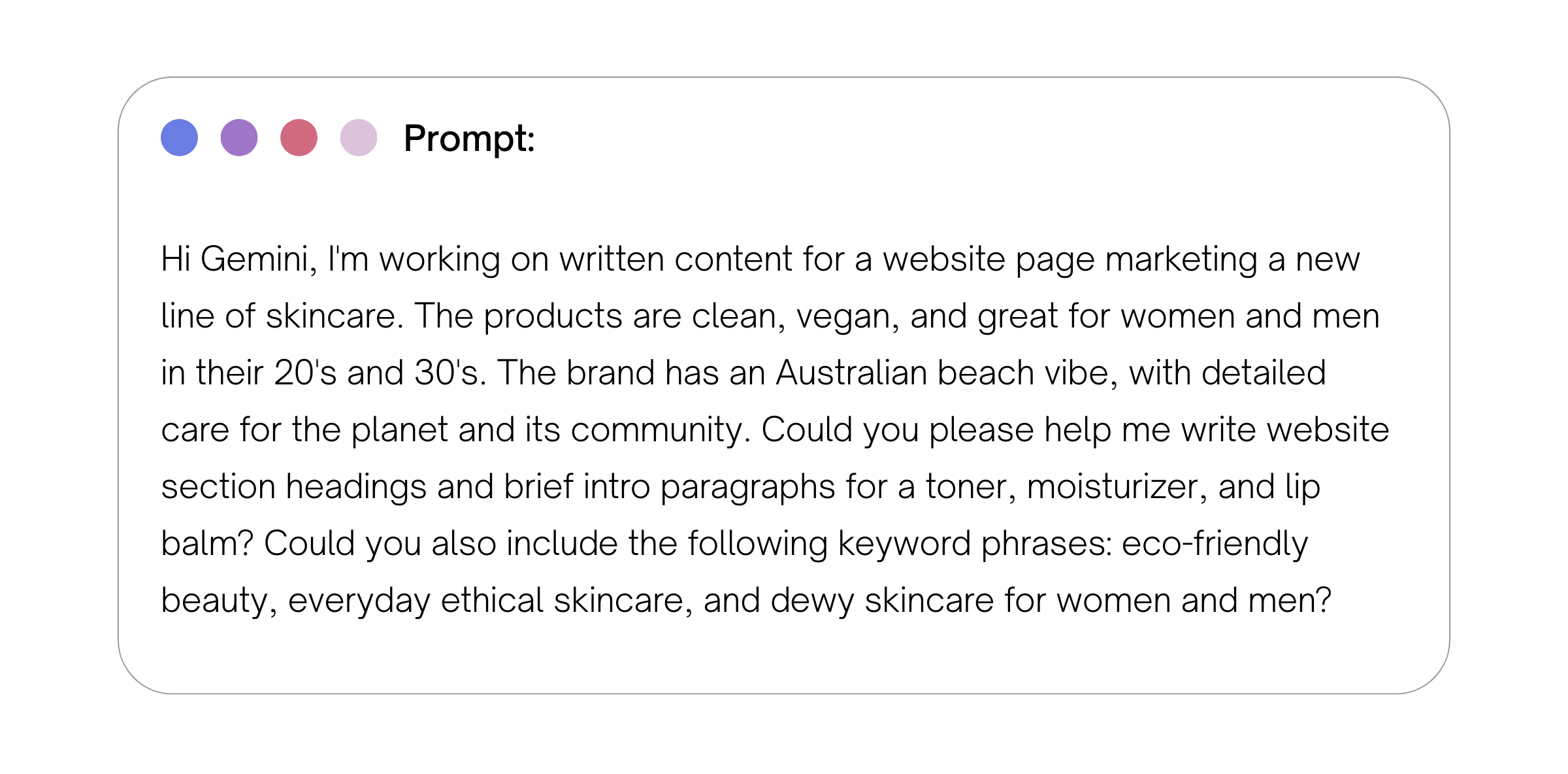
I then use Gemini's response as a draft—or as placeholder text—then tweak and edit as needed, all of which works together for the final written website copy. (For privacy and ethical reasons, I do not use specific client names or products while brainstorming written copy or drafts. Keeping it vague still helps!)
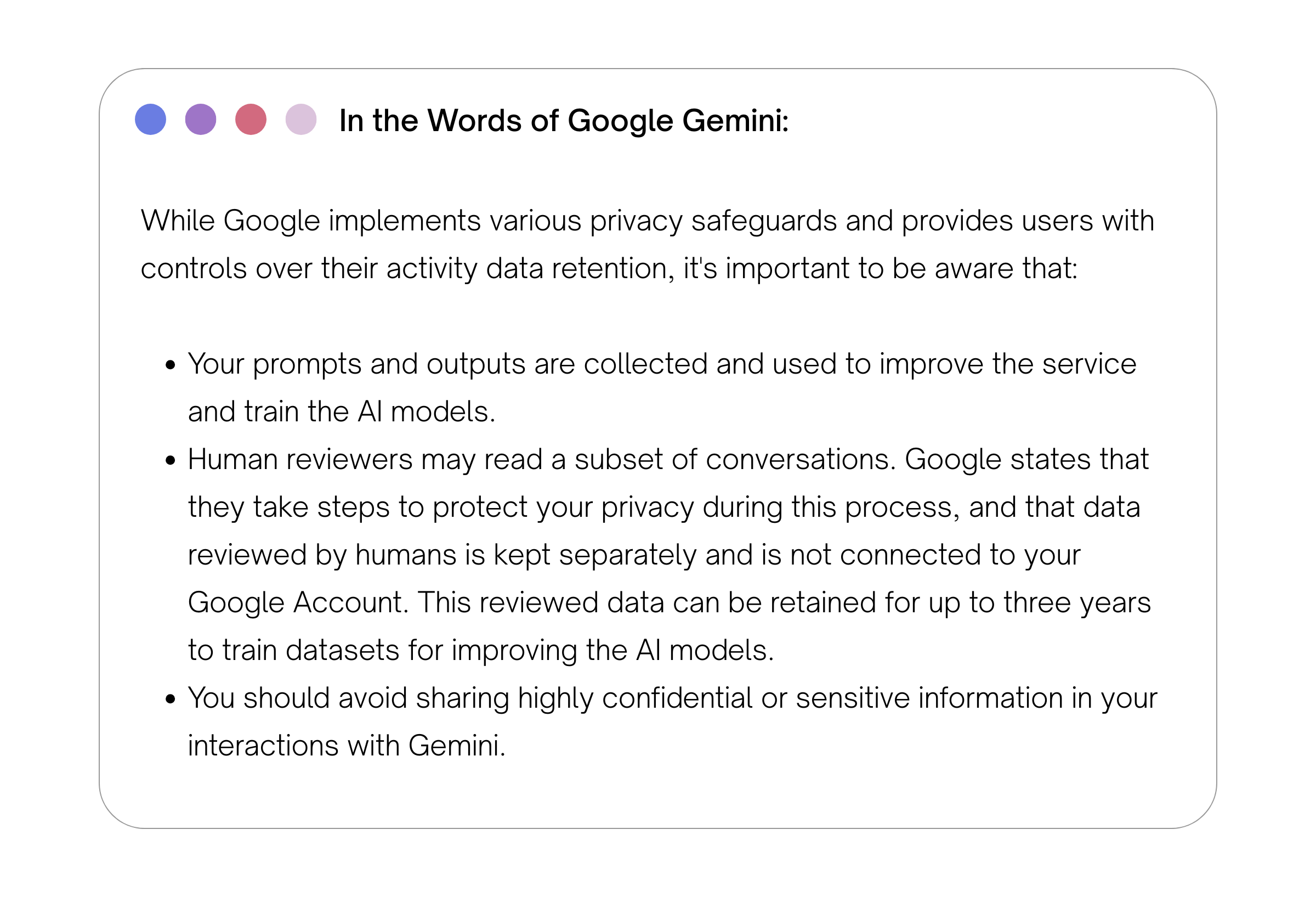
Here is a note from Gemini itself on its current Privacy Policy:
AI for Content Writing + Blog Posts
Long-form content writing, such as articles and blog posts, has been much more fun (and greatly improved) with the help of Google Gemini. I realize this might not resonate with post-millennial generations, but I see similarities between the research and writing process of the pre-Internet era and today's AI-powered possibilities.
For those educated in the '80s and '90s, writing and research meant visiting the library, having a general understanding of the Dewey Decimal System and card catalogs, hoping a book would be on the shelf when you found it, and diving into stacks of non-fiction books, encyclopedias, or interviewing people with more knowledge on the subject.
Here in the US, before the internet prevailed, we were taught the art of writing important facts or quotes on a notecard, carefully citing our sources according to our chosen citation method, diligently writing key information, and then piecing it all together to create something new. This method of gathering facts and synthesizing information formed the foundation for creating original work: presenting a fresh perspective, summarizing key insights, and ultimately, rephrasing to claim ownership of our unique written expression.
Engaging with AI tools like Google Gemini for long-form content has sparked a vivid sense of déjà vu from the 1990s. I begin with an idea, a personal viewpoint, a few basic facts and figures, maybe an analogy, and pose a question or prompt. What happens next is a process similar to those early research days, albeit at lightning speed.
When I present an idea or a question, it's as if Gemini becomes a hyper-efficient research assistant, capable of understanding and "thinking" beyond my original query. Gemini offers a wealth of related information and perspectives. Reviewing its output, selecting relevant insights and phrases, and using them as a springboard for a first draft mirrors the earlier experience and memories I have from the days in the library in elementary school.
As I navigate its output, I select the sentences, words, or elements that resonate with my main topic, assembling a preliminary draft—a digital equivalent to the "Rough Draft" growing up. (Yet, instead of only having Microsoft Word to help with spellcheck and synonyms, I now use tools such as Grammarly—which I am using as I write this post!)
The thoughtful act of editing remains the same: refining the language, rephrasing, and imbuing the text with my voice and individual perspective to transform the AI-generated content into something clear and unique.
Whether I'm writing long-form content for a blog post, article, or website copy, AI tools have not only been effective but also very helpful in organizing my thoughts, providing structure and clarity, and taking my idea just a bit further than I could alone, hence communicating more efficiently. (And for that, it sounds like I have everyone else who has had similar ideas before me to thank, thank you!)
AI for SEO + Meta Descriptions
Once a website is designed and ready to be 'Published,' it is important to ensure it is set up correctly for basic Search Engine Optimization (SEO).
Adding a Meta Description to each page helps ensure clarity on search engines and increases your website's visibility in searches. Meta Descriptions are crawled by search engines and also show up under the Page Title in search results. Typically, a short sentence or two summarizing the page content, Meta Descriptions can be drafted quickly with AI Marketing Tools, or simply Google Gemini or ChatGPT. (For bonus points, first ask the AI tool what makes a good meta description for your industry or product!)
Website platforms, such as Squarespace, WordPress, and Shopify, are quickly adapting and adding AI features to the backend. These AI tools assist in writing website copy, product information, and meta descriptions.
For example, Squarespace recently added a tool to do a quick SEO Audit of your website from the backend. In a few minutes, the result provided a list of missing Meta Descriptions and Alt Text, as well as editable AI suggestions to fill in the missing pieces—yes, please! Squarespace also has an AI feature on the toolbar, allowing you to draft written website content from AI within the platform.
AI for Social Media Content + Digital Marketing
Similar to the tools above, AI tools are great at assisting with creating written content for your brand and providing insights into planning a Content Calendar or Digital Marketing Strategy.
There are some excellent paid platforms that might work well for mid-to-large businesses. As a small business owner, I used JasperAI for a year (and enjoyed it), but soon realized I could use the free versions of Google Gemini or ChatGPT to achieve similar results (so that's what I do now).
If you're looking for a paid platform, here are some I've researched and would recommend depending on your needs: Jasper.ai, Copy.ai, and Writer.com.
However, as far as I know, AI won't do ALL the work for you just yet! (If you find a tool that does, please feel free to let me know what that tool is!)
Similarly to website platforms, it's also important to stay abreast of the AI updates social media platforms are making within the platforms themselves.
Your AI Personal Assistant: Streamlining Daily Tasks
Simply put, it's nice to have Gemini as a friendly personal assistant—and yes, I say 'please' and 'thank you' when I talk to her/him/it. :-)
Gemini has helped me streamline ideas, organize my thoughts, answer basic questions related to daily tasks, provide outlines and next steps, and write with clarity.
I often have ideas, and admittedly, sometimes struggle to put them into words and convey them. AI has improved my ability to articulate, write, and share ideas, and to create clearer written content for websites, blog posts, descriptions, and more.
Over the past year, it has been fun to discover "the art of the prompt." The more thorough and descriptive the prompt, the more delightful the AI output.

Embracing the Future, One Algorithm at a Time and The Human Touch
The world of AI for website design and digital marketing is still evolving, and quickly at that. (I’m excited to see what the future holds!) My advice to my fellow designers? Don’t be afraid to explore these new tools. Embrace them as collaborators, and let them help you level up your design game and your business.
Here are a few other AI platforms I have not used but will keep an eye on!
Although many people believe human input is still needed for AI tools, I can envision how that might change before too long. I've heard, "AI is a powerful tool, but it lacks the empathy, strategic thinking, and nuanced understanding of human connection that a designer brings to the table." Yet, empathy and reasoning seem simple enough in many everyday prompts (and AI is likely continually learning). So, what if we teach it to be empathetic... a strategic thinker... with a human touch?
What are your thoughts on AI in design? Please share your experiences in the comments below or send me a note—I’d love to learn about your AI tips and tools!
Note: I utilized Google Gemini as a writing assistant to generate initial drafts and refine language. Which is then further edited by me and Grammarly.